Yes. A foreign company can employ someone in the UK without setting up a UK company. Whether it has to run UK payroll itself depends mainly on whether it has a presence in the UK. If it does, it must operate PAYE like any UK employer. If it does not, it can choose to operate PAYE voluntarily, or the employee may have to pay their own tax and National Insurance to HMRC. Employer National Insurance, pension auto-enrolment and right to work checks follow their own rules, set out below.
This guide is for overseas groups with one to three people in the UK. Often the UK payroll was looked after by a large advisory firm that has had to step away, and the small headcount makes it hard to find a provider who takes it seriously. Then the mistakes start: wrong tax codes, missed pension deductions, payslips that arrive late. The rules are not hard once you know which ones apply to you.
This is a general guide. International employment can turn on the detail, so speak to HMRC or an adviser about your situation.
Can a foreign company employ someone in the UK? The short version
| Your situation | Who operates PAYE |
|---|---|
| UK branch, agency, office or representative office | You must operate PAYE |
| No UK presence, and you choose to run UK payroll | You operate PAYE voluntarily |
| No UK presence, and the employee works for a UK business | That UK business must operate PAYE, unless you do |
| No UK presence and no UK business involved | The employee may pay their own tax and NI through a direct payment arrangement |
When a non-resident employer must run UK payroll
What counts as a UK presence
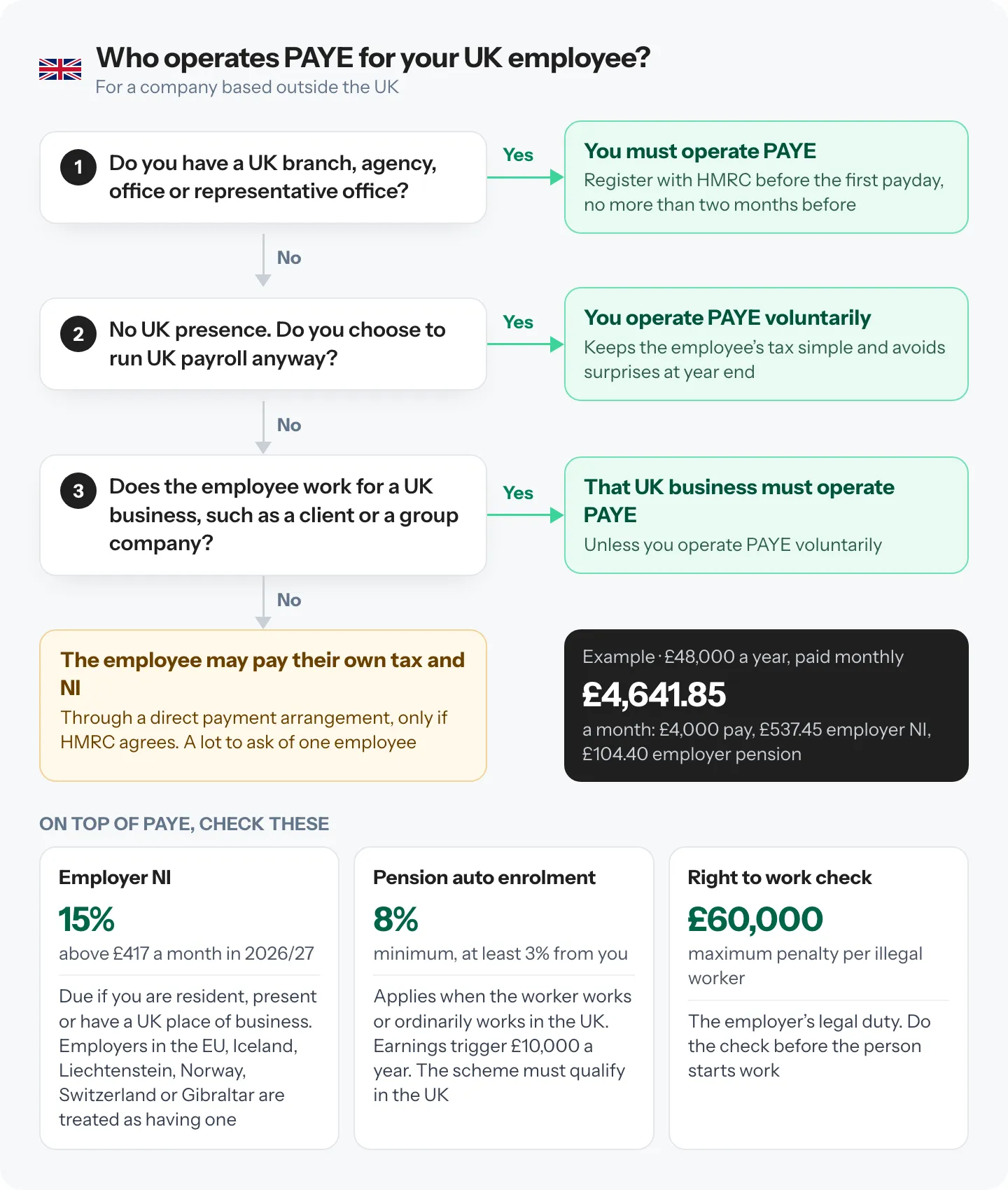
PAYE has a territorial limit. HMRC’s Globally mobile employees and PAYE guidance says you only have to operate PAYE if you have sufficient presence in the UK for the obligation to be enforced.
HMRC’s PAYE manual (PAYE81610) explains that a UK branch, agency or representative office establishes a tax presence. HMRC needs a UK address where it can contact the employer. Having employees in the UK is not enough on its own. Sales staff working from home do not create a presence at their home address, and using UK banks or lawyers does not either.
No UK presence: voluntary PAYE or the employee pays
Without a UK presence you can still choose to operate PAYE. Many overseas employers do, because it keeps the employee’s tax simple and avoids surprises at the end of the year.
If you send the employee to work for a UK business, such as a client or a group company, that UK business must operate PAYE on what you pay them, unless you operate PAYE voluntarily.
Where there is no employer to operate PAYE, HMRC can agree a direct payment arrangement. Under PAYE75040, this is used for overseas employers with no UK presence, where tax is likely to be due and the employee is willing and able to operate PAYE correctly on their own pay. If they are not, HMRC deals with them through Self Assessment instead. In practice, asking one employee to run their own PAYE is a lot to ask.
Registering as an employer with HMRC
If you operate PAYE, you register as an employer with HMRC. GOV.UK says you must register before the first payday to get your employer PAYE reference, and you cannot register more than two months before you start paying people.
Employer National Insurance for non-UK employers
Employer (secondary Class 1) National Insurance has its own test. GOV.UK’s guidance on National Insurance for short-term business visitors explains it:
- Normal rule. An employer is liable if it is resident, present or has a place of business in the UK (regulation 145 of the Social Security (Contributions) Regulations 2001).
- Employers in the EU, Iceland, Liechtenstein, Norway, Switzerland or Gibraltar. Where the employee pays UK National Insurance, the employer is treated as having a place of business in the UK, so employer NI is due even without a UK office. The worker and employer can agree that the worker handles the payments, but the employer remains liable.
- Countries with a social security agreement with the UK. These agreements usually say nothing about employer NI, so the normal UK rule applies.
- No UK presence at all. UK law may still make someone else the secondary contributor, for example a UK business the employee works for (HMRC’s manual, NIM33730).
The employee’s own position matters too. If someone is sent to the UK by an employer in the EU and has a PDA1, or a certificate of coverage under another social security agreement, GOV.UK says you can accept it as proof that they do not pay UK National Insurance. Some employees sent from other countries are exempt for their first 52 weeks (New employee coming to work from abroad).
Worked example
A US company with a UK representative office hires one UK-based employee on £48,000 a year, paid monthly (£4,000 a month). Using the 2026 to 2027 rates:
- Employer NI: (£4,000 − £417 secondary threshold) × 15% = £537.45 a month
- Pension, employer minimum: (£4,000 − £520) × 3% = £104.40 a month
- Pension, employee contribution at 5% of the same band: £174.00 a month
The employer’s monthly cost is about £4,641.85 before any other benefits. Income tax and employee NI come out of the employee’s £4,000 through PAYE.
Auto-enrolment applies to UK workers
The Pensions Regulator says the location of the employer is not what decides whether duties apply. What matters is whether the worker is working or ordinarily works in the UK. So an overseas employer of a UK-based employee has the same duties as a UK employer: assess them, enrol eligible staff, pay contributions and declare compliance.
For 2026/27 the earnings trigger is £10,000 a year (£833 a month). Minimum contributions are 8% of earnings between £6,240 and £50,270 a year, with at least 3% from the employer. The scheme must be one that qualifies in the UK: since 1 January 2021 a non-UK scheme generally cannot be used for auto-enrolment (The Pensions Regulator: cross-border schemes).
Right to work checks are the employer’s duty
Checking that an employee has the right to work in the UK is the employer’s legal duty, and it should be done before they start. GOV.UK says an employer can face a civil penalty of up to £60,000 for each illegal worker, and that penalties can apply where checks are missing or not done properly (Penalties for employing illegal workers). If your overseas company is the employer, the check is yours to do; an immigration adviser can confirm how this applies if you have no UK presence.
Use GOV.UK’s right to work guidance to see which documents to check.
Payslips
UK employees and workers must get a payslip on or before payday. If pay varies with the hours worked, the payslip must show the hours. A payslip from your home-country system, in another currency or format, may not meet this.
UK payroll without a UK entity: your options
Once you know you need to run PAYE, there are three practical choices:
- Run it yourselves with UK payroll software. Fine if someone in the group knows UK payroll and has the time each month.
- Ask the employee to pay through a direct payment arrangement. Only where you have no UK presence and HMRC agrees, and it puts the burden on your employee.
- Use a managed payroll provider. A UK specialist runs each pay run, files with HMRC, deals with the pension and answers your questions.
Givver is HMRC-recognised payroll software that sends RTI submissions, sends payslips automatically and manages pensions. With managed payroll, a named CIPP-qualified Givver payroll specialist runs each pay run from the data in Givver, and your team approves it. The same service is available in any EU country, which helps a group with staff in more than one place.
FAQs
Can a foreign company run UK payroll without a UK entity?
Yes. It can register as an employer with HMRC and operate PAYE, either because it has a UK presence or voluntarily.
Does a non-resident employer have to pay employer National Insurance?
It depends on where the employer is based. Employers resident, present or with a place of business in the UK are liable. Employers in the EU, Iceland, Liechtenstein, Norway, Switzerland or Gibraltar are treated as having a UK place of business where the employee pays UK National Insurance.
Does auto-enrolment apply if the employer is overseas?
Yes, if the worker works or ordinarily works in the UK. The employer’s location does not decide it.
Who checks right to work for a UK employee of an overseas company?
The employer. Do the check before the person starts work, and take immigration advice if you have no UK presence.
Make UK payroll one less thing to chase
A small UK team should not mean a payroll that goes wrong every month. Work out whether you have a UK presence, register with HMRC, sort employer NI and the pension, and give your employee proper payslips. Then make sure someone who knows UK payroll is running it.