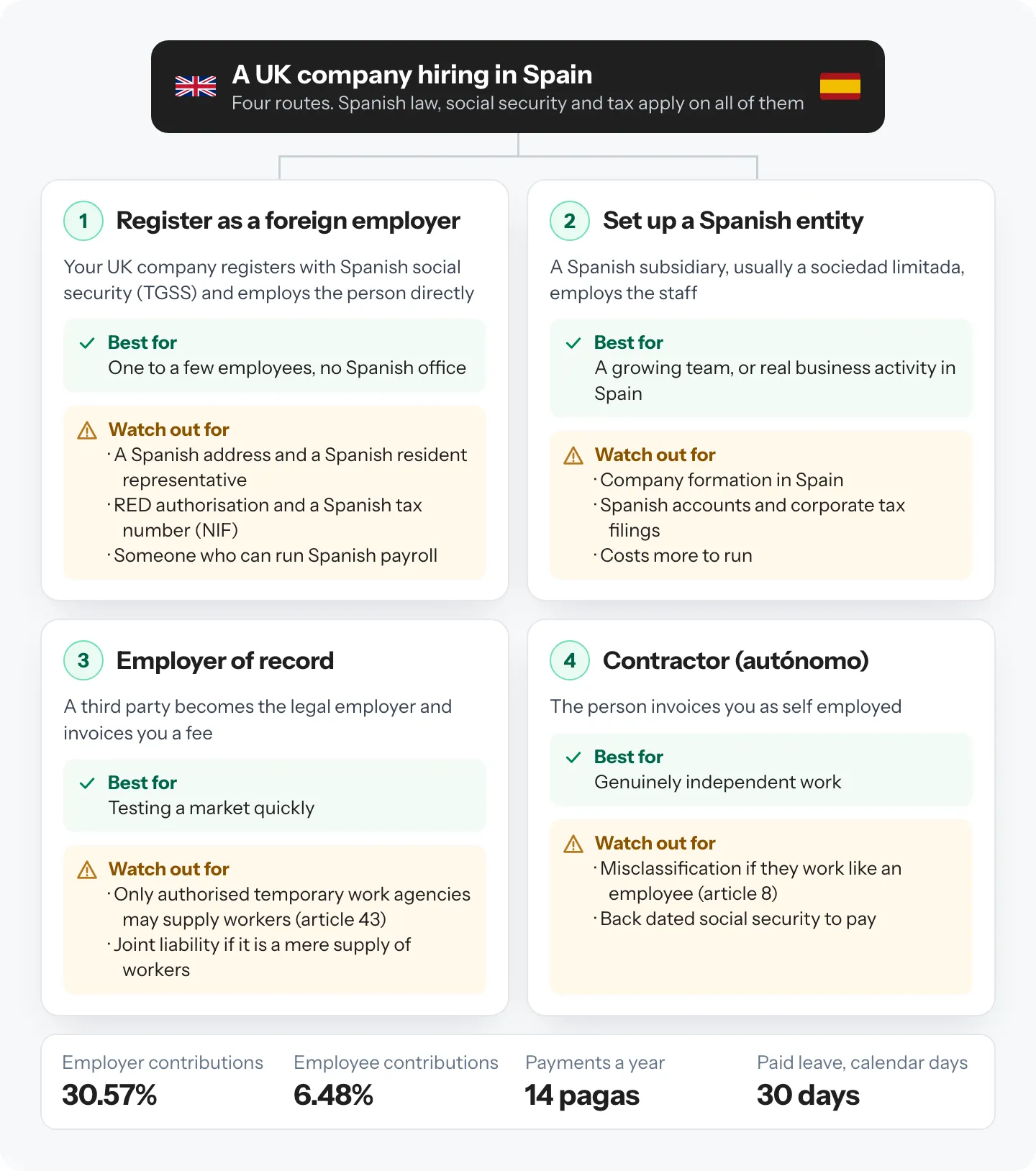
Yes. A UK company can employ someone in Spain without opening a Spanish company. It can register as an employer with Spanish social security, set up a Spanish entity, use an employer of record, or engage the person as a contractor. Whichever route you choose, Spanish employment law, Spanish social security and Spanish tax apply to work done in Spain, so the real question is not “can we?” but “who runs the payroll, and who checks it?”
This guide is for a UK company employing staff in Spain: a handful of people, or one employee who moved there. Often payroll sits with a local adviser, payslips arrive with errors, the provider is hard to reach, and nobody in the UK knows enough Spanish payroll to challenge the tax treatment, let alone the time-recording rules and leave tracked in hours.
This is a general guide, not legal or tax advice. Rules depend on the collective agreement for the role, so take local advice before you hire.
Can a UK company employ someone in Spain? The four routes
| Route | What it means | Best for | Watch out for |
|---|---|---|---|
| Register as a foreign employer | Your UK company registers with Spanish social security and employs the person directly | One to a few employees, no Spanish office | You need a Spanish address, a Spanish-resident representative and someone who can run Spanish payroll |
| Set up a Spanish entity | A Spanish subsidiary employs the staff | A growing team, or real business activity in Spain | Company formation, accounts and corporate tax filings in Spain |
| Employer of record | A third party employs the person and invoices you | Testing a market quickly | Spain’s rules on supplying workers to another business (see below) |
| Contractor | The person invoices you as self-employed (autónomo) | Genuinely independent work | Misclassification if they work like an employee |
Route 1: register as a foreign employer without an entity
A UK company with no establishment in Spain can register as an employer with the Tesorería General de la Seguridad Social (TGSS). A Spanish Ministry of Labour information note, based on Royal Decree 84/1996, sets out what this involves:
- Register before work starts. You apply online for inscription and a contribution account code (código de cuenta de cotización, CCC). You do not need a workplace in Spain, but you must give an address in Spain.
- Appoint a representative in Spain. An employer based abroad must name a representative with an address in Spain for dealings with the TGSS. That can be the employee or an external adviser.
- Use the RED system. Employers must file through the Seguridad Social’s RED system, so the representative needs a RED authorisation.
- Get a Spanish tax number. You need a Spanish tax identification number (NIF) and your company documents with a legalised translation.
The ministry note was written for an EU employer, so ask the TGSS (Spain’s social security treasury) which extra documents a UK company needs, such as legalised or apostilled company papers.
Income tax. Spanish tax rulings take the general position that a foreign employer that does not operate in Spain, through a permanent establishment or otherwise, is not obliged to withhold Spanish income tax (IRPF). The employee then declares the salary in their own Spanish tax return. Whether your company’s activity in Spain creates a permanent establishment or a withholding duty depends on the facts, so confirm it with a Spanish tax adviser.
Route 2: set up a Spanish entity
A Spanish subsidiary (usually a sociedad limitada) employs the staff, withholds IRPF and pays social security like any Spanish company. It costs more to run, but suits a growing team or real business activity in Spain. If you also run several UK companies, see how multi-entity payroll keeps them separate on the UK side.
Route 3: employer of record
An employer of record (EOR) becomes the legal employer and charges you a fee. Be careful in Spain. Article 43 of the Workers’ Statute (Estatuto de los Trabajadores, BOE) says hiring workers to supply them temporarily to another company may only be done through authorised temporary work agencies. Where the arrangement is a mere supply of workers, both businesses are jointly liable to the worker and to social security, and the worker can choose to become a permanent employee of either.
Route 4: contractors
Some companies engage the person as a self-employed contractor. Spanish law presumes an employment contract exists where someone provides a service within another person’s organisation and direction in return for pay (Workers’ Statute, article 8). If your “contractor” works set hours, uses your tools and reports to your managers, the relationship may be treated as employment, with back-dated social security to pay.
How Spanish payroll works
Social security
Employer and employee both pay social security on a contribution base, which includes the share of the extra payments. The Seguridad Social’s 2026 rates for the general scheme on a permanent contract are:
| Contribution | Employer | Employee |
|---|---|---|
| Common contingencies | 23.60% | 4.70% |
| Unemployment (permanent contract) | 5.50% | 1.55% |
| Wage guarantee fund (FOGASA) | 0.20% | none |
| Vocational training | 0.60% | 0.10% |
| Intergenerational equity mechanism (MEI) | 0.67% | 0.13% |
| Total | 30.57% | 6.48% |
The employer also pays an accident and occupational illness premium that depends on the activity. For 2026 the maximum monthly base is €5,101.20.
IRPF withholding
Where the employer must withhold, the IRPF rate depends on salary, family situation and region, and is recalculated when circumstances change. See the Agencia Tributaria.
14 pagas: two extra payments a year
Workers in Spain are entitled to two extraordinary payments a year (pagas extraordinarias), one at Christmas and the other in the month set by the collective agreement or by agreement with workers’ representatives. A collective agreement can allow them to be spread across the 12 monthly payments (Workers’ Statute, article 31).
Worked example
An employee on a permanent contract earns €42,000 a year, paid in 14 payments of €3,000.
- Monthly contribution base (including the extra payments spread over 12 months): €42,000 ÷ 12 = €3,500
- Employer social security: €3,500 × 30.57% = €1,069.95 a month, plus the accident premium
- Employee social security: €3,500 × 6.48% = €226.80 a month
- Employer social security over the year: €42,000 × 30.57% = €12,839.40, plus the accident premium
In the two months with an extra payment (December and the month the agreement sets) the employee receives €6,000 gross, and the payroll has to handle the double payment correctly.
Daily time recording (registro de jornada)
Article 34.9 of the Workers’ Statute requires the employer to keep a daily record of each worker’s start and finish times. The records must be kept for four years and be available to workers, their representatives and the labour inspectorate. The government has proposed requiring these records to be digital, so check the current position before you set up a system.
Leave, often tracked in hours
The minimum paid annual leave in Spain is 30 calendar days (article 38), and it cannot be swapped for money. There are up to 14 paid public holidays a year, two of them local (article 37.2), so the calendar depends on where the employee lives. Many collective agreements express working time and leave in hours, which is why Spanish payslips and leave records often count hours rather than days.
What a gestoría does
A gestoría is a Spanish administrative agency. For a small foreign employer it typically registers the company, acts as the Spanish representative, files through RED and prepares payslips. Quality varies, so agree up front who answers your questions, in what language, and how quickly.
The UK side
Does UK National Insurance still apply?
Usually not. Under the UK’s social security arrangements with the EU, someone working in just one EU country usually pays social security in that country. The exception is a detached worker: an employee of a UK employer sent to work temporarily in an EU country for up to two years. They can stay in UK National Insurance if HMRC issues a certificate of coverage (also called a PDA1). See GOV.UK: Paying National Insurance if you’re going to work in the EU and Employees working abroad.
An employee who has moved to Spain for good is not a detached worker, so Spanish social security applies.
UK PAYE
GOV.UK says employers must continue to deduct PAYE from payments to employees working abroad, and that employees going abroad for a year or more can complete form P85 so HMRC can confirm their tax code. Spain may also tax the same pay, so contact the HMRC Employer Helpline and take Spanish advice to avoid paying twice.
Right to live and work in Spain
Immigration is a separate question from payroll. UK nationals who were living in Spain before 1 January 2021 are covered by the Withdrawal Agreement. Others may need a work permit or visa (GOV.UK: Living in Spain).
FAQs
Can a UK company employ someone abroad without a local entity?
Often, yes. In Spain it can register with Spanish social security as a foreign employer and appoint a Spanish-resident representative. Other countries have their own rules.
Is an employer of record legal in Spain?
Spain only allows authorised temporary work agencies to supply workers to another business. Ask the provider how its model complies with article 43 of the Workers’ Statute, and take advice.
What is gestoría payroll?
It is payroll run by a Spanish gestoría, an administrative agency that files social security and tax and prepares payslips for small employers.
Do I have to pay 14 salaries in Spain?
Employees are entitled to two extra payments a year. The annual total is the same whether they are paid separately or spread across 12 months, where the collective agreement allows it.
Getting help with Spanish payroll
Spanish payroll is manageable once you know the moving parts. What matters most is someone who runs it properly and explains it in plain English. Givver payroll specialists run managed payroll for employers in the UK and any EU country, including Spain. Givver’s payroll software is for UK payroll only.
Talk to sales about your team in Spain.