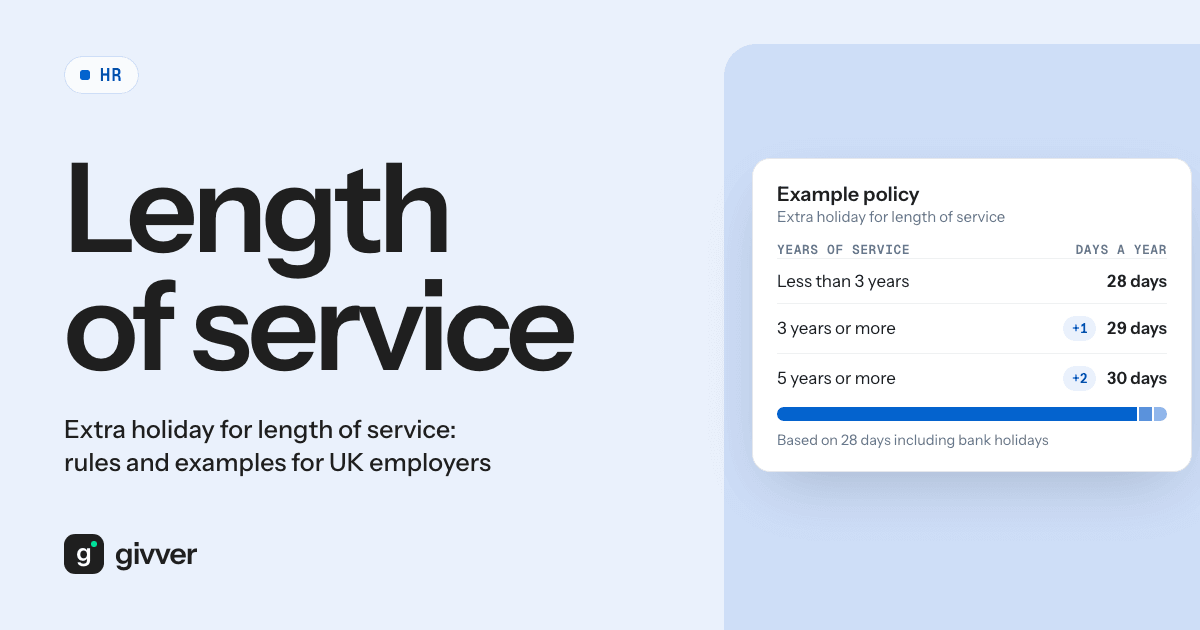
There is no legal requirement in the UK to give extra holiday for length of service. It is a contractual benefit you choose to offer. You can reward up to five years’ service without having to justify it. Beyond five years, the Equality Act 2010 expects you to reasonably believe it fulfils a business need, because longer service schemes tend to favour older staff.
The law is the easy part. The hard part is running it: someone adds extra days by hand at each year end or anniversary, part-timers get the wrong figure, and nobody is sure whether long-service days sit in the same pot as normal annual leave.
Extra holiday for length of service and age discrimination
Benefits linked to service can be indirect age discrimination, because younger people are less likely to have long service. Schedule 9, paragraph 10 of the Equality Act 2010 gives employers an exception:
- It is not age discrimination to give someone less of a benefit because they have shorter service than a colleague.
- If the person’s service is more than five years, you can only rely on the exception if you reasonably believe the scheme fulfils a business need.
- You can measure service either as all their time with you, or as time worked at or above a level you reasonably regard as appropriate. You may, where reasonable, discount periods of absence.
Acas gives the example of an extra day’s holiday for each year of service up to five years, which does not need to be objectively justified. For longer service, set out the business need in writing, for example retaining experienced staff in roles that are hard to fill. Whether a business need is strong enough depends on the facts, so speak to Acas or an employment adviser before extending a scheme beyond five years.
The Equality Act covers England, Scotland and Wales. Northern Ireland has its own age discrimination law; nidirect describes the same five-year limit.
Length of service holiday entitlement: common banding examples
Three common patterns for a full-time employee on 25 days plus bank holidays:
| Scheme | After 2 years | After 3 years | After 4 years | After 5 years | After 10 years |
|---|---|---|---|---|---|
| One day a year, capped at five years | 26 | 27 | 28 | 29 | 29 |
| Steps at 3 and 5 years | 25 | 27 | 27 | 29 | 29 |
| Five-year step, then a ten-year step | 25 | 25 | 25 | 27 | 29 |
The first two stay within the five-year exception. The third adds a day at ten years, so it needs the business-need test.
Extra days holiday for length of service in the UK: when the increment applies
You need to decide when the extra day starts. There are two common methods.
On the anniversary. The day is added on the employee’s service anniversary. It is precise but fiddly: you pro-rate the extra day for the rest of the leave year.
Example: the leave year runs January to December. An employee reaches five years’ service on 1 July 2026 and earns one extra day. For 2026 they get half a day (6 of 12 months remaining), and the full day from January 2027.
From the start of the next leave year. The extra day applies from the first leave year that starts after the anniversary. In the example, it starts on 1 January 2027. It is simpler to run, but the employee waits up to a year.
Whatever you pick, write it down and use the same rule for everyone.
Part-time staff: pro-rata the extra days
Part-time workers should get the same benefit pro rata. Work out the full-time figure first, then scale it.
Example: a full-time employee with five years’ service gets 29 days plus bank holidays. A colleague with the same service works three days a week: 29 × 3 ÷ 5 = 17.4 days, plus a pro-rata share of bank holidays. If you record leave in hours, convert the days into hours using their contracted day length.
How long-service days interact with the 5.6-week minimum and carry-over
Almost all workers are entitled to 5.6 weeks’ paid holiday, capped at 28 days, and bank holidays can count towards it. Long-service days sit on top of this as contractual leave. GOV.UK says employers do not have to apply all the statutory rules to extra leave, so your contract decides how it works.
That gives you a few decisions to make:
- One allowance or two? Most employers show a single total, but keep track of which part is statutory and which is contractual. It matters on termination and when holiday is carried over.
- Which days are used first? Say whether holiday taken uses statutory leave first or contractual leave first.
- Carry-over. A relevant agreement can allow the 1.6 weeks of additional statutory leave to be carried into the next leave year (Working Time Regulations, regulation 13A). Carry-over of enhanced holiday depends on the contract (Acas: carrying over holiday). Many employers let long-service days be carried over but cap the number. See our guide to holiday carry-over rules for policy options.
Writing it into your holiday policy
A good long-service clause answers these questions:
- How many extra days, and at what service points.
- How service is measured, including whether periods of absence are discounted and whether service with a previous employer counts (for example after a TUPE transfer).
- When the increment applies: anniversary, next leave year, or current leave year.
- How it is pro-rated for part-time staff and people who join or leave mid-year.
- Whether long-service days can be carried over, and how many.
- For schemes beyond five years, the business need behind them.
FAQs
Is extra holiday for length of service a legal requirement?
No. UK law sets a minimum of 5.6 weeks. Anything above that, including long-service days, is up to the employer and the contract.
Can I give extra holiday after ten years’ service?
Yes, but because it rewards more than five years’ service, you must reasonably believe it fulfils a business need. Record your reasons and take advice.
What is long service leave?
In the UK it usually means extra annual leave earned through service, or a one-off paid break such as a sabbatical at a milestone. The same age discrimination rules apply.
Do part-time employees get length of service holiday?
They should get the same benefit pro rata to their working pattern, to avoid treating them less favourably than full-time colleagues.
Keep the rules simple
A clear policy, one rule for when the increment applies and a record of statutory and contractual leave remove most of the year-end work. Givver’s leave management keeps holiday requests in one place, with Google Calendar and Outlook Calendar sync.