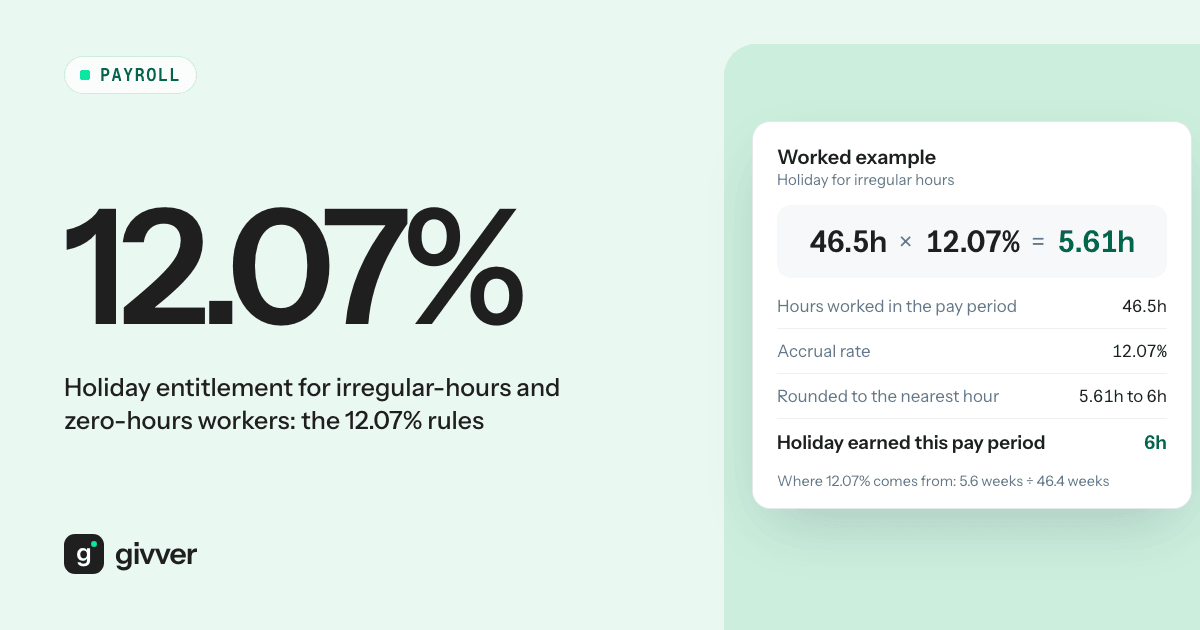
Holiday entitlement for irregular-hours workers builds up as they work. For every leave year starting on or after 1 April 2024, a zero-hours, casual or bank worker earns 12.07% of the hours they actually work in each pay period, rounded to the nearest hour, up to the 5.6-week statutory maximum. Employers can instead pay rolled-up holiday pay of 12.07% of pay, shown separately on every payslip.
Care homes and retailers with bank staff know where this goes wrong. Hours change every week, someone works out the leave by hand from timesheets, and by the end of the year nobody is sure the balance is right. This guide sets out the rules from GOV.UK and Acas, with worked examples you can check against your own numbers.
Who counts as an irregular-hours or part-year worker
The definitions come from the 2024 changes to the Working Time Regulations, explained in GOV.UK’s holiday pay and entitlement reforms guidance:
- Irregular-hours worker: under their contract, the number of paid hours they work in each pay period is wholly or mostly variable. Zero-hours, casual and bank contracts usually fall into this group (Acas).
- Part-year worker: their contract requires them to work only part of the year, and there are periods of at least a week in that year which they are not required to work and for which they are not paid. Their hours can be fixed.
A worker with fixed hours on a rotating shift pattern is not an irregular-hours worker, even if the pattern changes week to week. Their leave works differently, as covered in our guide to holiday entitlement for shift workers.
These rules apply to leave years beginning on or after 1 April 2024. By now every leave year has started after that date, so they apply to all irregular-hours and part-year workers.
Holiday entitlement for irregular hours: the 12.07% accrual
GOV.UK’s holiday entitlement guidance says irregular-hours and part-year workers are entitled to 12.07% of the hours they work in a pay period. Acas adds that the leave builds up on the last day of each pay period.
Why 12.07%? It is 5.6 weeks of leave divided by the 46.4 weeks left to work in a year (5.6 / 46.4 = 12.07%). If your contract gives more than the statutory minimum, the percentage goes up. GOV.UK’s example: 6 weeks of leave gives 13.04% (6 / 46).
Rounding
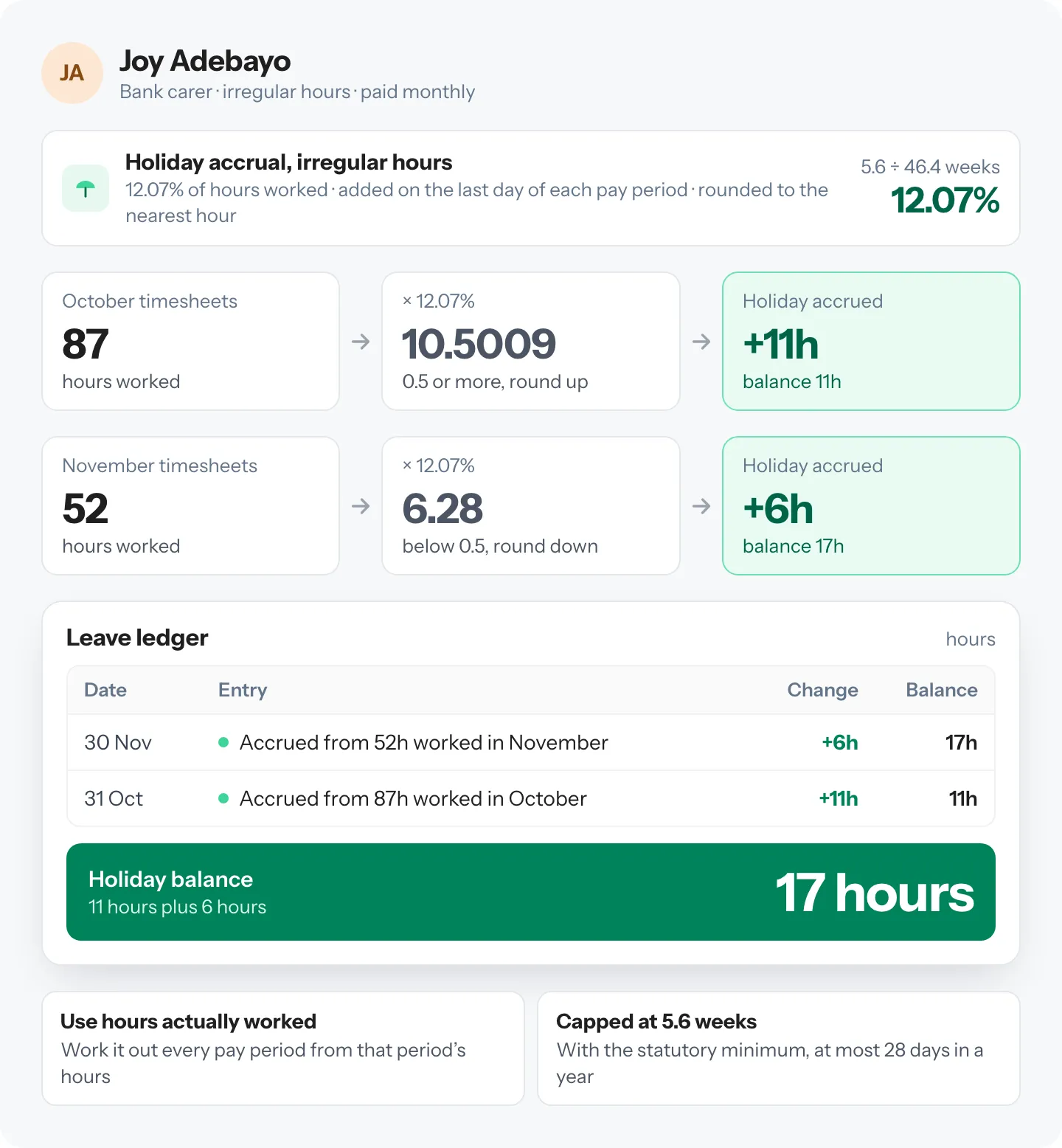
GOV.UK says the result must be rounded up to the nearest hour if it is 0.5 of an hour or more. Below half an hour it can be rounded down, to zero if needed. For workers paid weekly who work 4 hours or less, the reforms guidance says it may be appropriate to round up to the next half hour or hour so they do not lose out.
Worked examples
| Pay period | Hours worked | x 12.07% | Leave accrued |
|---|---|---|---|
| Weekly (GOV.UK example) | 30 | 3.621 | 4 hours |
| Monthly (GOV.UK example) | 68 | 8.2076 | 8 hours |
| Monthly | 87 | 10.5009 | 11 hours |
| Weekly | 4 | 0.4828 | 0 hours, or round up (see above) |
Do this every pay period, using the hours actually worked in that period. A bank carer who works 87 hours in October and 52 in November accrues 11 hours, then 6 hours (52 x 12.07% = 6.28).
The 5.6-week cap
Accrual stops at the statutory maximum. Acas says that with only the statutory minimum, the most holiday these workers can accrue in a year is 28 days. Very few zero-hours workers come near it, but check anyone working close to full-time hours.
Acas also says employers can let workers take holiday before it has accrued, and should plan ahead for leave that builds up in the last pay period of the leave year, for example by agreeing that it carries over.
Holiday pay for irregular hours: the 52-week rate
When an irregular-hours worker takes leave, GOV.UK says they are paid their average pay from the previous 52 weeks, counting only weeks in which they were paid. If a week had no pay, count back another week, up to a maximum of 104 weeks. All of their leave is paid at their normal rate, which includes commission and regular overtime but does not usually include bonuses.
The reforms guidance adds that weeks off sick or on maternity or other family leave are also left out of the reference period.
Holiday pay calculator for irregular hours: worked example
A retail worker has been paid in 45 of the last 52 weeks. You count back 7 more paid weeks, staying within 104 weeks, so you have 52 paid weeks. Their pay in those weeks totals £13,520.
- £13,520 / 52 = £260 a week of holiday pay
GOV.UK’s guidance gives a weekly figure and does not set a method for leave taken in hours. For leave taken before the worker has completed a week, it says to pay an amount that fairly represents their pay for the time on leave. A common approach is to divide the same 52 weeks’ pay by the hours worked in them to get an hourly holiday rate. If you do that, write the method down and check it with an adviser.
Rolled-up holiday pay
Instead of paying holiday when it is taken, employers can pay rolled-up holiday pay to irregular-hours and part-year workers, and only to them. GOV.UK and Acas set the conditions:
- at least 12.07% of the worker’s total pay in each pay period
- shown as a separate item on every payslip
- paid at the same time as the pay for the work done in that period
- workers should be told before it starts, and contracts checked
The worker still has the right to take time off. Acas says employers must make sure workers can take the holiday they are entitled to and encourage them to take it; they simply get no further pay when they do, because it has already been paid.
Worked example
A bank worker does 22 hours at £13.00 an hour in a week.
- Pay for work: 22 x £13.00 = £286.00
- Rolled-up holiday pay: £286.00 x 12.07% = £34.52, as its own line on the payslip
A monthly-paid worker on 96 hours at £13.50 earns £1,296.00, so the rolled-up holiday pay is £156.43.
If a worker is off sick or on statutory family leave during a pay period, Acas says the rolled-up holiday pay for that time is the average from the 52 weeks before the leave began.
Our earlier holiday entitlement and pay FAQs cover rolled-up pay for casual staff in shorter form.
Carrying over leave
The normal limit, per GOV.UK, is up to 8 days carried over when someone gets 28 days, if the contract allows. The reforms guidance gives irregular-hours and part-year workers more in some situations:
| Situation | Irregular-hours and part-year workers |
|---|---|
| Could not take leave because of sickness | Up to 28 days, to be used within 18 months of the end of the leave year |
| Could not take leave because of maternity or other family leave | All of the entitlement |
| Employer refused leave, gave no reasonable chance to take it, or did not warn it would be lost | All of the entitlement |
Leave carried over under rolled-up holiday pay has already been paid for.
Holiday pay for irregular hours and part-year workers: other points
- Bank holidays. There is no statutory right to bank holidays off. For staff on fixed part-time days, see our guide to bank holiday entitlement for part-time workers.
- Leavers. Accrued leave not taken is paid in lieu when employment ends.
- Records. From 6 April 2026, GOV.UK says employers must keep detailed records of annual leave and holiday pay for at least six years.
Accrual is only as good as the hours it is based on. Approved timesheets give you a reliable figure for each pay period, and payslips are where rolled-up holiday pay must appear as its own line.
FAQs
How do you calculate holiday pay for a zero-hours contract?
Accrue 12.07% of the hours worked each pay period. When leave is taken, pay the average weekly pay from the last 52 paid weeks (looking back up to 104 weeks). Or pay rolled-up holiday pay of 12.07% of pay each period.
What is the holiday entitlement on a zero-hours contract?
5.6 weeks a year, built up as 12.07% of hours worked, to a maximum of 28 days.
Is rolled-up holiday pay legal?
Yes, for irregular-hours and part-year workers in leave years starting on or after 1 April 2024. It is not allowed for regular-hours workers.
Do I round 12.07% up or down?
To the nearest hour: 0.5 or more rounds up, less than 0.5 can round down.
This is general information, not legal advice. The rules are recent, so check the GOV.UK guidance or speak to Acas or an adviser about a specific case.
The 12.07% rule takes a minute per worker per pay period. Across a whole bank of staff, it is easier when hours, leave and pay sit in one place. See how Givver handles this.