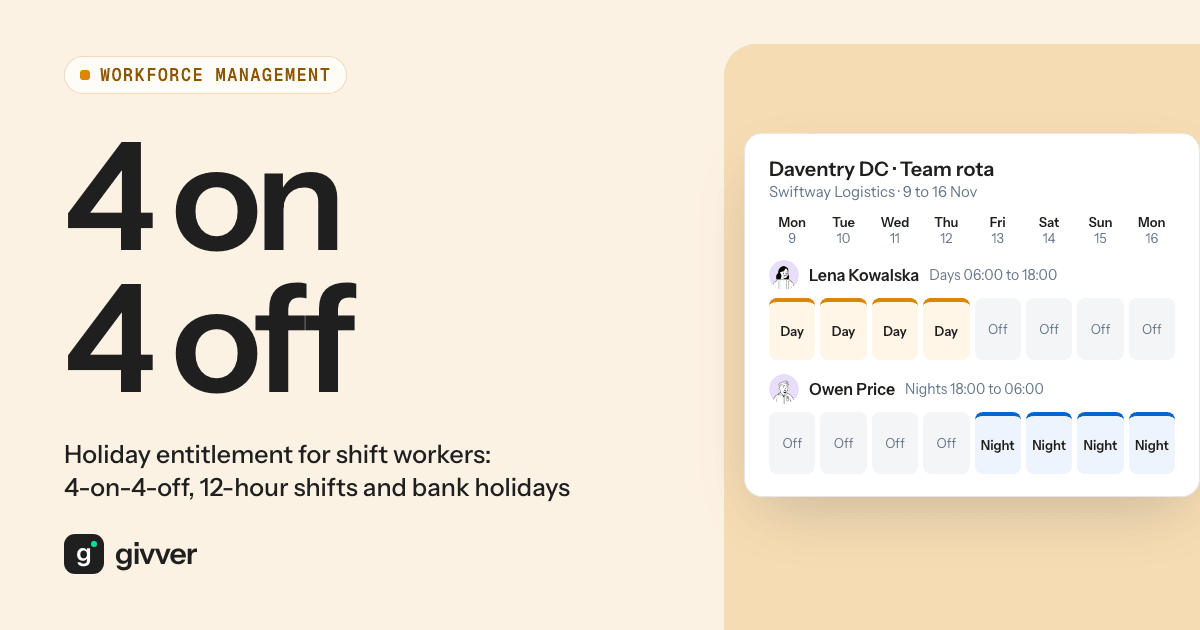
Holiday entitlement for shift workers starts from the same rule as everyone else: at least 5.6 weeks of paid leave a year. The work is turning 5.6 weeks into shifts or hours for a rota that does not look like Monday to Friday. A worker on 4-on-4-off works an average of 3.5 shifts a week, so their statutory minimum is 19.6 shifts (3.5 x 5.6). On 12-hour shifts that is 235.2 hours.
If you run a care home, a contact centre, airport ground handling or a 24/7 retail site, you know the harder version. The rota never repeats neatly, contracts say “any five days in seven”, some shifts are 12 hours and some are 6, and when the balance says “14 days left”, nobody is sure what a day means. Here is the method, a reference table and the bank holiday rules.
Holiday entitlement for shift workers starts at 5.6 weeks
GOV.UK’s holiday entitlement guidance says most workers are entitled to 5.6 weeks’ paid holiday a year. For someone working five days a week that is 28 days. Statutory paid holiday is capped at 28 days, so someone who works six days a week still gets 28 days, not 33.6.
How to convert holiday entitlement into shifts
Work out the average number of shifts a week, then multiply by 5.6. The government’s 2019 guidance on calculating holiday entitlement for different contract types uses this formula:
Average shifts a week = (shifts in the pattern / days in the pattern) x 7
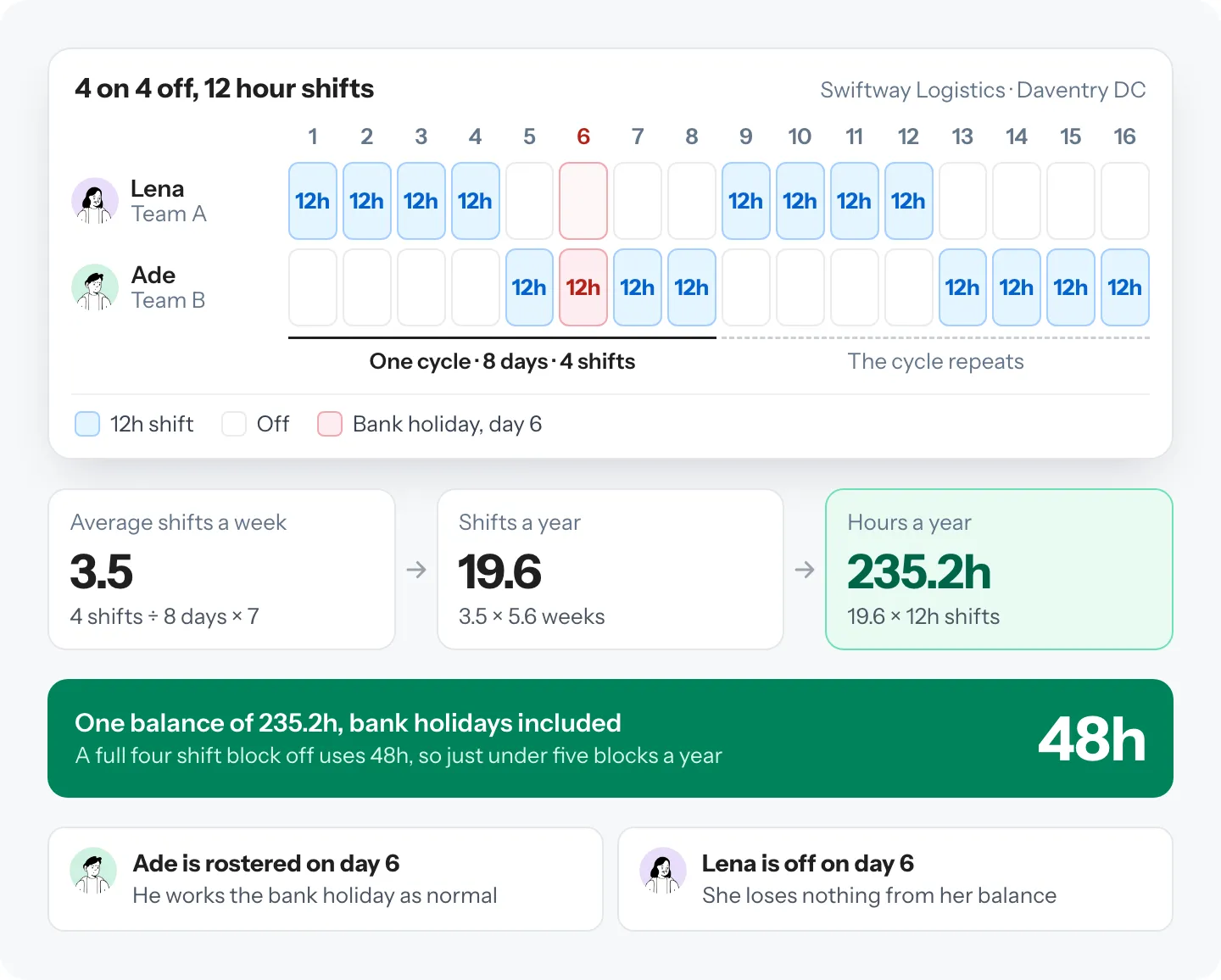
For 4-on-4-off, the pattern is 8 days long with 4 shifts in it:
- 4 / 8 x 7 = 3.5 shifts a week
- 3.5 x 5.6 = 19.6 shifts a year
The same guidance points out that the shift method assumes every shift is the same length. If shift lengths vary, use hours instead (more on that below).
4 on 4 off holiday entitlement in the UK: what a tribunal said
The 19.6 figure has been tested. In Rayment v Noonan Services Group (2019), the Birmingham Employment Tribunal looked at a worker on a 4-on-4-off pattern. It said his statutory entitlement was 19.6 days (3.5 x 5.6). He had already received 21 days. His claim for 16 more days, for bank holidays he had not worked, was a contractual matter above the legal minimum, and the tribunal dismissed it because it could not hear that contract claim while he was still employed.
It is a first-instance tribunal decision, so it does not bind other tribunals, and it was a short judgment on jurisdiction rather than a ruling on calculation. Treat it as an illustration of the 3.5 x 5.6 approach, not a precedent.
Holiday entitlement for 12-hour shift workers: book in hours, not days
If every shift is the same length, booking one shift as one unit of leave works. When lengths vary, it stops being fair.
Worked example: mixed shift lengths
A care assistant works 36 hours a week: two 12-hour shifts and two 6-hour shifts. That is 4 shifts a week on average.
| Booking method | Entitlement | If they book only 12-hour shifts | If they book only 6-hour shifts |
|---|---|---|---|
| Shifts (4 x 5.6) | 22.4 shifts | 268.8 hours off (7.5 weeks) | 134.4 hours off (3.7 weeks) |
| Hours (36 x 5.6) | 201.6 hours | 201.6 hours off (5.6 weeks) | 201.6 hours off (5.6 weeks) |
Booked in shifts, the result depends on which shifts the worker picks, and one extreme falls below the 5.6-week minimum. Booked in hours, the worker always gets exactly 5.6 weeks.
So for 12-hour rotas, keep the balance in hours and deduct the actual length of each rostered shift taken off. A 4-on-4-off worker on 12-hour shifts has 235.2 hours. Taking a full four-shift block off uses 48 hours, so they can take just under five full blocks a year.
Reference table: holiday entitlement for common shift patterns
All figures are the statutory minimum (5.6 weeks), before any extra contractual leave. Hours assume every shift in the pattern is the length shown.
| Pattern | Average shifts a week | Shifts a year | Hours a year |
|---|---|---|---|
| 4-on-4-off, 12-hour shifts | 3.5 | 19.6 | 235.2 |
| 3 x 12-hour shifts a week | 3 | 16.8 | 201.6 |
| 4 x 10-hour shifts a week | 4 | 22.4 | 224 |
| 2-2-3 rotating (7 shifts in 14 days), 12-hour shifts | 3.5 | 19.6 | 235.2 |
| 5-on-3-off (5 shifts in 8 days), 8-hour shifts | 4.375 | 24.5 | 196 |
| “Any five days in seven”, 7.5-hour shifts | 5 | 28 | 210 |
| Six shifts a week, 8-hour shifts | 6 | 28 (capped) | 224 |
Any continental or rotating pattern averaging 3.5 shifts a week over a full cycle comes out at 19.6 shifts.
Holiday entitlement calculator for 4 on 4 off
If you want to check a figure quickly:
- Count the shifts in one full cycle of the rota and the number of calendar days in the cycle.
- Divide shifts by days and multiply by 7 to get average shifts a week.
- Multiply by 5.6 (but no more than 28 days’ worth) to get shifts a year.
- Multiply by the shift length to get hours a year.
For starters and leavers part-way through the leave year, pro-rate the annual figure by the part of the leave year they are employed.
Bank holiday entitlement for shift workers
There is no statutory right to bank holidays off, or to extra pay for working them. GOV.UK says bank or public holidays do not have to be given as paid leave, and an employer can choose to include them in the 5.6 weeks. Anything more, such as time and a half for working Christmas Day, is set by the contract.
For 24/7 rotas, a simple approach is to include bank holidays in one annual balance (for example 235.2 hours on 4-on-4-off). Whoever is rostered on a bank holiday works it; whoever is off loses nothing.
Three points from Acas guidance on bank holidays:
- An employer cannot make someone use a holiday day for a bank holiday that falls on a day they do not normally work.
- A worker cannot be paid in lieu of bank holidays, except for unused leave when they leave the job.
- Whether a worker gets any extra one-off bank holiday depends on their contract.
Part-time staff on fixed days raise a separate question about fairness, covered in our guide to bank holiday entitlement for part-time workers. Whatever you choose, write it down. The Rayment case shows how arguments start when a contract promises bank holiday leave in a way that does not fit a rota.
Regular-hours shift workers are not irregular-hours workers
A worker on a fixed rotating pattern is a regular-hours worker, even if their week changes from one week to the next. GOV.UK’s guidance on the 2024 holiday reforms says a worker with fixed hours on a rotating shift pattern is not an irregular-hours worker.
That matters because irregular-hours and part-year workers have different rules: they build up leave at 12.07% of hours worked each pay period and can be paid rolled-up holiday pay. Regular-hours shift workers cannot. If your bank staff or zero-hours staff work alongside contracted rota staff, see our guide to holiday entitlement for irregular-hours and zero-hours workers.
Holiday pay for regular shift workers
GOV.UK says a regular-hours shift worker’s holiday pay is based on the average number of weekly fixed hours worked in the previous 52 weeks, at their average hourly rate. “Normal” pay includes regular overtime and commission, so if shift premiums or overtime are paid regularly, check whether they belong in the holiday pay rate. See our page on overtime and shift premiums.
From 6 April 2026 employers must also keep detailed records of annual leave and holiday pay for at least six years, according to GOV.UK.
How to make the numbers trustworthy
Managers stop trusting leave balances when the balance is in one unit and the rota is in another. Use one unit across the business (hours work for every pattern), put the calculation in the policy, not just the answer, and deduct the hours of the shift actually rostered. Givver covers both leave management and rotas and shift scheduling.
FAQs
How many days holiday do you get on 4 on 4 off?
The statutory minimum is 19.6 shifts a year (3.5 average shifts a week x 5.6). On 12-hour shifts that is 235.2 hours. Your contract may give more.
Do shift workers get bank holidays off?
Not by law. Bank holidays can be part of the 5.6 weeks, and whether you work them depends on the rota and your contract.
Should 12-hour shift workers book holiday in days or hours?
Hours, unless every shift is exactly 12 hours. Booking in days or shifts gives the wrong answer when shift lengths vary.
This guide is general information, not legal advice. For a specific contract, speak to Acas or an employment adviser.
Shift rotas will never be as tidy as a Monday-to-Friday week, but the calculation can be. Pick one unit, write the method down, and book leave against the real rota. See how Givver handles this.