Will AI replace HR? No. AI is taking over parts of the job, mostly first drafts, routine questions, filing and summarising. The parts that need judgement, trust and legal accountability stay with people. What is changing is the mix of work in an HR role and the skills it needs.
Is AI going to replace HR jobs?
Some HR work will shrink, and it is fair to say so. In the CIPD’s Autumn 2025 Labour Market Outlook, a survey of 2,019 senior HR professionals and decision-makers, 17% of employers expected AI to shrink their workforce over the next year. Of those, 62% said clerical, junior managerial, professional or administrative roles were most likely to go.
That is a warning for any role made mostly of admin, in HR or anywhere else. It is not a forecast that HR as a function disappears. HR exists because employing people involves law, conflict, judgement and trust, and none of those go away when a tool can write a letter.
What AI is taking on in HR
These are the tasks where AI already does useful work, with a person checking the result:
- First drafts. Policies, letters, job descriptions, announcements and training outlines. Our AI prompts for HR professionals shows how.
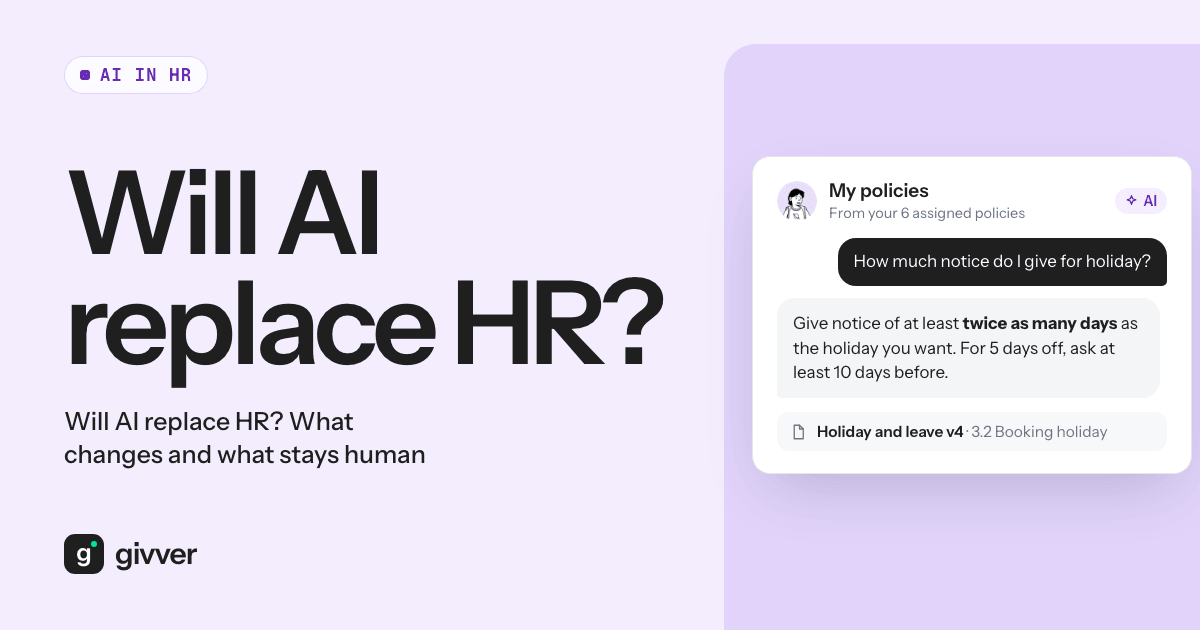
- Answering routine questions. “How much holiday do I have left?”, “What does the sickness policy say?”, “Why is my pay different this month?”
- Filing. Reading documents and suggesting which employee record they belong to.
- Summarising. Long guidance, consultation papers and anonymised survey comments.
For 10 worked examples, with the risk to manage in each, see how to use AI in HR.
Can AI replace human resources work that needs judgement?
No, and in several areas it should not try.
- Employee relations. Settling a dispute between two colleagues needs someone both sides trust.
- Investigations. Disciplinary and grievance investigations follow the Acas Code of Practice, weigh evidence and credibility, and end in decisions a tribunal may later examine.
- Sensitive conversations. Bereavement, ill health, redundancy, a pregnancy announcement. People need a person.
- Judgement calls. Whether to extend a probation period, how to handle a reasonable adjustment, what is fair in a situation no policy anticipated.
- Culture. How people treat each other is shaped by leaders and HR, not by a chatbot.
- Legal accountability. The employer is responsible for decisions about people. Under UK GDPR, significant decisions made solely by automated means carry safeguards, including the right to human intervention and to contest the decision (Article 22C, as inserted by the Data (Use and Access) Act 2025). And under the Equality Act 2010, you cannot blame a tool for discrimination. See AI and employment law in the UK for more.
Will HR be replaced by AI? What changes in HR roles
The likely change is less time on admin and more on work that needs a person. In practice that means:
| Less of | More of |
|---|---|
| Writing letters and policies from scratch | Editing and checking AI drafts against UK law |
| Answering the same question many times | Handling the questions that need judgement |
| Filing and chasing documents | Reviewing the documents a tool was unsure about |
| Reading long guidance end to end | Deciding what a change means for your business |
| Manual data gathering | Workforce planning and job design |
New skills come with that shift. The CIPD’s research on how AI is changing HR skills (fieldwork by YouGov, January to February 2026) found 67% of HR professionals were confident learning to use AI tools. Confidence was lower for the harder parts: 46% of HR leaders were confident leading job redesign and 40% designing reskilling pathways. The gap is less about using the tools and more about redesigning work around them.
How HR teams can prepare
- Write an AI policy. Decide which tools are approved, for which tasks, and what data never goes in. Our AI policy for employees template will help.
- Use AI yourself, on low-risk work. Drafting and summarising are the best place to learn what it does well and where it goes wrong.
- Learn the rules on automated decisions. Know where the UK GDPR safeguards apply, and keep an eye on the ICO’s draft guidance on automated decision-making, which was consulted on until 29 May 2026 and is still a draft at the time of writing.
- Build the human skills. Investigations, difficult conversations, coaching managers, job design. These are the parts of HR that grow in value.
- Check the outputs. The new risk is not that AI replaces HR; it is that people stop checking what it produces.
Where Givver stands
At Givver we use AI where it saves time, not AI first. It drafts policies for admins to share, answers employees’ questions about their assigned policies and their own pay, and sorts uploaded documents, sending anything it is unsure about to a person to review. Customer data is not used to train AI models. The decisions stay with your team. More on AI in Givver.
FAQs
Will AI replace HR?
No. It is taking on drafting, routine questions, filing and summarising. Employee relations, investigations, sensitive conversations and decisions about people stay human.
Is AI going to replace HR jobs?
Roles made mostly of admin are most exposed. Roles that combine admin with judgement, employee relations and advice are more likely to change than disappear.
Can AI make HR decisions?
It can support them, but decisions about hiring, discipline, dismissal and pay need meaningful human involvement. Solely automated significant decisions carry legal safeguards under UK GDPR.
What skills will HR need?
Checking AI output, data protection basics, job and work design, workforce planning, and the people skills no tool can replace.
AI will not replace HR, but it will change what a good HR week looks like. To see how Givver fits AI into everyday HR and payroll, talk to sales.