In a contact centre or a care home, nobody works the same days two weeks running. So when someone rings in sick, payroll has to work out which days count, what each day is worth, and whether the absence links to the last one, often before the rota for next week is even published.
Statutory sick pay for shift workers follows the same rules as for everyone else. SSP is paid for qualifying days, the days the employee would normally have worked. For shift workers, the practical answer is to agree that the rostered shifts are the qualifying days. The daily rate is the weekly SSP rate divided by the number of qualifying days in that SSP week (Sunday to Saturday), so it can change from week to week as the rota changes.
Statutory sick pay changes from April 2026
The Employment Rights Act 2025 changed SSP from 6 April 2026. GOV.UK’s employer guide and its page on absences that span 6 April 2026 confirm three changes:
- No waiting days. SSP is now payable from the first full day of sickness absence. The three unpaid waiting days have gone.
- No lower earnings limit. SSP is available to eligible employees regardless of their earnings.
- A new rate rule. SSP is £123.25 a week or 80% of average weekly earnings, whichever is lower, for 6 April 2026 to 5 April 2027 (rates and thresholds 2026 to 2027).
What did not change: SSP is still paid for up to 28 weeks, and an employee is no longer eligible once a series of linked absences lasts more than 3 years.
For absences that started before 6 April 2026 and carried on past it, transitional rules apply. One example: employees already on SSP and earning between £125 and £154.05 a week are paid the £123.25 flat rate rather than 80% of earnings until they return to work or their entitlement ends. Check the GOV.UK transitional guidance for any absence that began before April. This guide is not legal advice: for an unusual case, speak to ACAS or an adviser.
How does SSP work for shift workers?
The employee must have an employment contract, have done some work under it, and be sick for at least one full working day. GOV.UK adds two rules that matter for shifts:
- A day only counts as a sick day if the employee did not work at all. If they work for a minute or more before going home sick, that day does not count.
- If a shift ends the day after it started (a night shift), and the employee becomes sick during or after it, they are not eligible for SSP for that shift.
Qualifying days when the pattern varies
GOV.UK’s manual calculation guidance sets out how qualifying days are decided:
- If you and the employee agree which days they are required to work, those are the qualifying days. You may agree a different basis from the contract, for example where the pattern changes each week.
- If you agree there are no working days in a week, Wednesday is the qualifying day.
- If you cannot agree which days are working days in a week, every day is a qualifying day except days on which you agree no employees work.
For shift workers, the cleanest approach is to write into the contract or sickness policy that qualifying days are the shifts on the published rota. If the rota for a week is not yet published, apply the agreed fallback. Whatever you choose, agree it in advance and apply it consistently.
Calculating sick pay for shift workers
Work through these steps for each absence.
- Find the average weekly earnings (AWE). Use all earnings subject to Class 1 National Insurance paid in the relevant period. That includes overtime and shift premiums paid in the period. The period ends on the last normal payday before the first full day of sickness and starts the day after the payday at least 8 weeks earlier. For weekly pay, add the earnings and divide by 8. For monthly pay, add them, divide by the number of months, multiply by 12 and divide by 52. Do not round at any stage.
- Set the weekly rate. Compare 80% of AWE with £123.25 and use the lower figure.
- Count the qualifying days in each SSP week, Sunday to Saturday.
- Divide the weekly rate by the qualifying days in that week to get the daily rate, then multiply by the qualifying days the employee was sick.
GOV.UK publishes unrounded daily rates at £123.25 a week: £17.6071 for 7 qualifying days, £20.5416 for 6, £24.65 for 5, £30.8125 for 4, £41.0833 for 3, £61.625 for 2 and £123.25 for 1.
Worked example: 4 on, 4 off
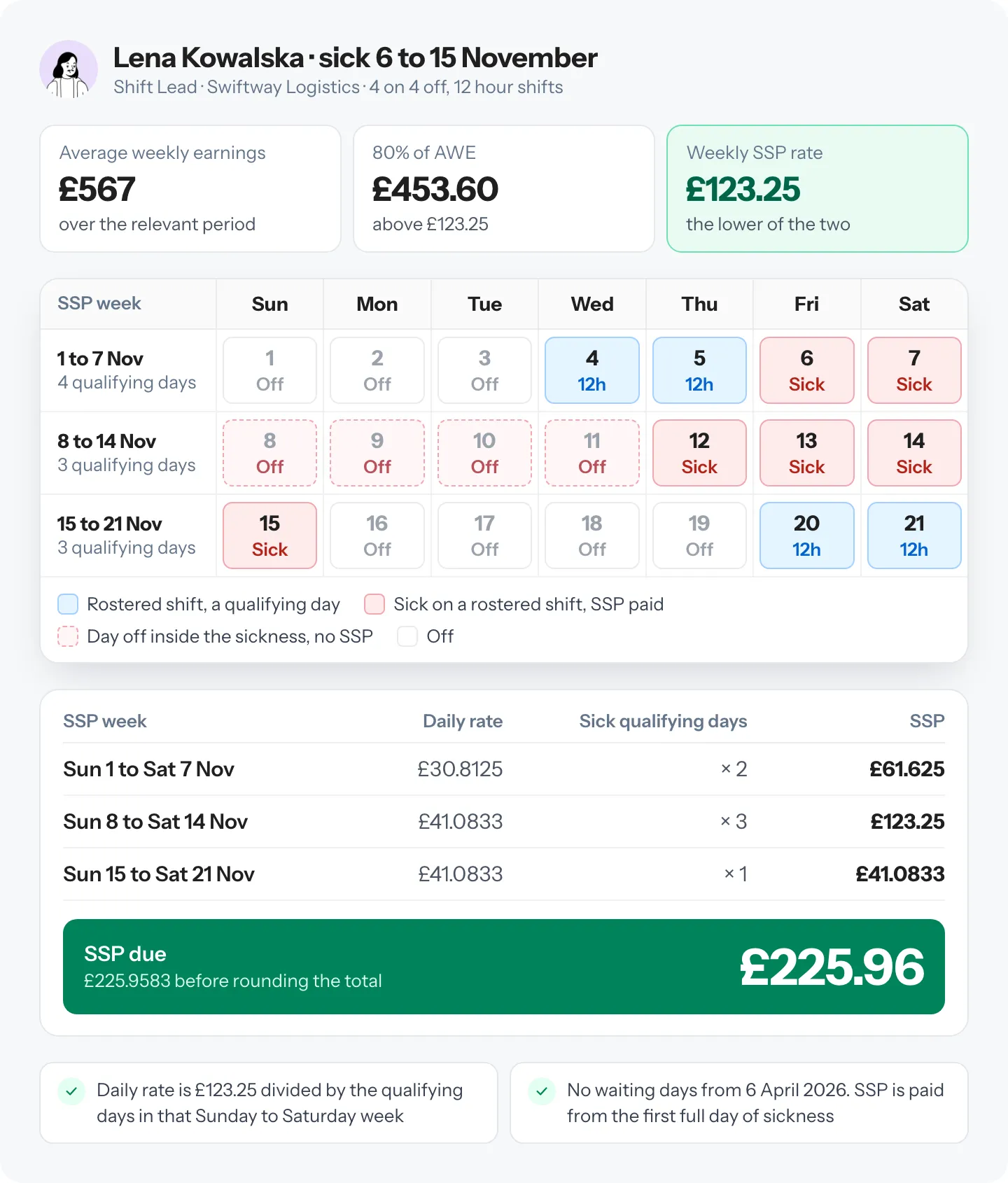
An employee works four 12-hour shifts then has four days off. Their AWE over the relevant period is £567, so 80% of AWE is £453.60. That is above £123.25, so the weekly rate is £123.25.
Because the cycle is 8 days long, each Sunday-to-Saturday week contains 3 or 4 shifts.
| SSP week | Rostered shifts (qualifying days) | Daily rate | Sick qualifying days | SSP |
|---|---|---|---|---|
| Sun 1 to Sat 7 Nov | Wed, Thu, Fri, Sat (4) | £30.8125 | Fri, Sat (2) | £61.625 |
| Sun 8 to Sat 14 Nov | Thu, Fri, Sat (3) | £41.0833 | Thu, Fri, Sat (3) | £123.25 |
| Sun 15 to Sat 21 Nov | Sun, Fri, Sat (3) | £41.0833 | Sun (1) | £41.0833 |
The employee is sick from Friday 6 to Sunday 15 November and back for their Friday 20 November shift. SSP due is £225.96 (£225.9583 before rounding the total). Days off in the middle of the absence still form part of the period of sickness, but SSP is only paid for the rostered shifts.
Worked example: a rotating rota and the 80% rule
A part-time care worker is paid weekly. Their earnings in the 8-week relevant period total £1,160, so AWE is £145 and 80% of AWE is £116. That is below £123.25, so the weekly rate is £116.
They are sick from Monday 2 to Tuesday 10 November.
| SSP week | Rostered shifts | Daily rate | Sick qualifying days | SSP |
|---|---|---|---|---|
| Sun 1 to Sat 7 Nov | Mon, Thu (2) | £58.00 | Mon, Thu (2) | £116.00 |
| Sun 8 to Sat 14 Nov | Sun, Tue, Wed, Fri, Sat (5) | £23.20 | Sun, Tue (2) | £46.40 |
SSP due: £162.40. Before April 2026, the first three qualifying days would have been unpaid waiting days.
Linked periods of incapacity
Two absences of at least one full day each, 8 weeks (56 days) or less apart, are linked and treated as one period. That matters for shift workers in three ways:
- The rate is fixed at the start of the first period and stays the same through the linked period, even if earnings have changed since.
- The 28 weeks of entitlement count across the linked periods.
- Eligibility is decided on the first day of the first period.
Keep the start date and AWE of each period on record.
Payroll cut-off and sickness that runs past it
SSP is paid on the normal payday for the same period as wages, with tax and NI deducted. When an absence runs past the payroll cut-off, pay SSP for the days you know about and pay the remaining days in the next run once the employee is back or the absence is confirmed.
Notice and evidence rules help here. The employee should tell you they are sick within your time limit, or 7 days if you have none. You can only ask for a fit note after more than 7 days in a row, and you cannot withhold SSP because a fit note is late.
Company sick pay on top of SSP
You can pay more than SSP through a company sick pay scheme, but never less than the SSP the employee is entitled to. Most schemes count SSP as part of the company payment, so check your policy wording. With shift workers, be clear whether company sick pay is based on rostered hours, average hours or contracted hours, because the answers differ for the same absence.
Record keeping
GOV.UK lets you choose how you keep sickness absence records, but HMRC may ask to see them if there is a dispute about SSP. For each absence, keep the dates, the qualifying days agreed for each week, the AWE calculation and the SSP paid.
Rota data and absence data in one place make this much easier. Givver covers rotas and shift scheduling, leave and absence and payroll, including statutory payments such as SSP. See also our guide to complex working patterns. For background on the reform, our earlier post SSP reform: what employers need to know ahead of April 2026 explains why the rules changed.
FAQs
What changed to statutory sick pay in April 2026?
From 6 April 2026, SSP is paid from the first full day of sickness, the lower earnings limit no longer applies, and the rate is £123.25 a week or 80% of average weekly earnings, whichever is lower.
What counts as sick pay for irregular hours?
The same SSP rules apply. Agree the rostered shifts as qualifying days, work out average weekly earnings over the relevant period, and divide the weekly rate by the qualifying days in each SSP week.
Does a night shift count as a sick day?
Not if the employee works any part of it. If a shift ends the day after it started and the employee becomes sick during or after it, GOV.UK says they are not eligible for SSP for that shift.
Get the rota and the payroll talking
SSP for shift workers is hard only when the rota, the absence and the payroll sit in different places. Bring them together and the qualifying days are already known when the payroll is run. See how Givver handles shifts, absence and payroll.